Showing posts with label Bhutan travel tips. Show all posts

Sunday, 5 January 2020

PARO - The valley of unsurpassed beauty

Bhutan, in its entirety, only encompasses about 47,000 sq. km; about the same amount of land as Switzerland. The Southern half of the country generally remains below 3,000 meters in altitude and has a number of valleys that serves as home to a majority of the country's population.  The vast majority of the country (72%) is covered in pine forests and the government that at no point in the future is the country to harvest lumber below the point of 60% coverage has decreed it.  The Northern half of Bhutan sees a dramatic increase in altitude as some of the highest peaks in the world are found in the Bhutanese Himalayas.  Containing thousands of lakes, hundreds of glaciers, and endless trekking paths, Northern Bhutan is one of the most amazing trekking destinations left in the world.

Paro is a valley town in Bhutan, west of the capital, Thimphu. It is the site of the country’s only international Paro airport and is also known for the many travel sacred sites in the area. North of town, the Taktsang Pelphug (Tiger’s Nest) monastery clings to cliffs above the forested Paro Valley. Northwest of here are the remains of a defensive fortress, Drukgyel Dzong, dating from the 17th century.

Drukgyel Dzong
Zhabdrung Ngawang Namgyal built this Dzong in 1646, to commemorate his victory over the Tibetan invaders. Though largely destroyed by fire in 1951, the outer walls and the central tower remain an imposing sight. On a clear day, you have a splendid view of Mt. Jumolhari from the approach road to Drukgyel Dzong.

Rinpung Dzong or the ‘Fortress of a Heap of Jewels’. Built in 1646 by Zhabdrung Ngawang Namgyal, the Dzong stands on a hill above Paro Township. It is linked by the traditional cantilever bridge (called the Nemi Zam) over the Pa Chu where one may pose a photograph.
Experience a walk up a paved stone path running alongside the imposing outer walls. Once inside the Dzong, the monks, architecture and the ancient frescoes, will welcome you.
  
On a ridge immediately above Rinpung Dzong is the Ta Dzong, built as a watchtower to protect the Dzong from intruders and warring factions.
In 1968 Paro’s Ta Dzong was inaugurated as the National
Museum, and now holds a fascinating collection of art, relics, religious thangkha paintings, Bhutan’s exquisite postage stamps, coins and handicrafts, together with a small natural history collection.
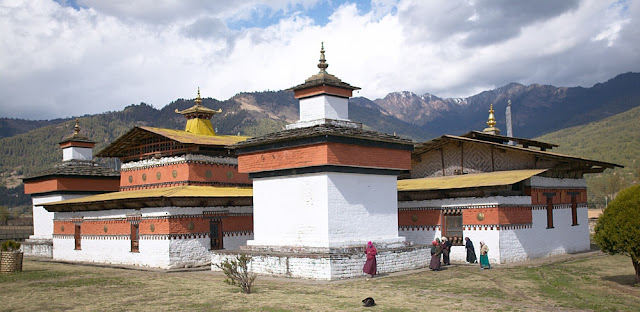
The temple is undoubtedly one of the oldest temples to have been built in Bhutan.
It is one of the 108 temples built by the Tibetan King Songtsen Gampo in the 7th century AD.
Because of Jowo (Buddha) as the main statue the temple was also known as Jowo Lhakhang. Other statues are of Lord Buddha Sakyamuni, and two of his disciples Maugalbu (Maudgalyana), Sharibu (Sariputra).
The latest extension was carried out in 1965 under the initiative of the Royal Queen Mother Ashi Kezang Choden Wangchuck. She added another new structure to the temple known as Guru Lhakhang.
Next to the temple is the house that is now turned into a museum dedicated to the late Dilgo Khyentse Rinpoche. One can come across photographs and other artifacts belonging to Rinpoche.

The temple is located below Chelela on the road to Ha. It is exactly twenty-seven kilometers from Bondey, Paro to the nearest road head and an hour’s walk from there to the temple.
Nothing much is known about the Kila Gonpa, however oral sources confirm it as having built by Siddhi Paw Dorji in the 9th Rabjung (cycle of sixty years starting from the Rabbit year). Later in the later part of the 17th century the 4th Chief Abbot Je Damchoe Pekar renovated and enlarged it into a two-storied structure. In between the temple was completely razed by a fire and was later rebuilt by the 25th abbot Je Sherub Gyeltshen.
The main relic in the temple is that of Chuchizhey (Avaloketeshvara) built by Je Sherub Gyeltshen. There are two Chortens (stupas). One contains the tooth of Je Sherub Gyeltshen and the other the tooth of Zhabdrung Jigme Norbu.
Currently the temple houses the Nuns and has about forty-five nuns.

It was built by Dewa zangpo, son of the great siddhi Thangtong Gyalpo. Dewa Zangpo was not simply an important architect, but also established the lineage of the Tachog Chojie, the descendants of which live close by the temple today. It is believed that the temple was renovated in the late 17th century during the reign of the 4th Desi. In 1980 the temple suffered minor damage due to an earthquake. Today the temple is taken care of by the Tachog Chojie families.
They conduct Kuchoe (death anniversary ritual) of Dewa Zangpo annually on the 1st day of the 9th month.

Is located atop an 800-meter cliff in Paro. Its history is associated with the visit of Guru Padmasambhava, the Indian saint who came to Bhutan in the 8th century AD.
The cave was named Taktshang after Guru Rinpoche flew into the cave from Kurtoe Singye Dzong in eastern Bhutan riding on a tigress.
When landing within the cave he took the wrathful form of Guru Dorji Drolo (one of the eight manifestations of Guru Rinpoche) to subdue the demons} it was also visited and blessed by many others. The foremost being Langchen Pelgi Sengye, one of the 25 disciples of Guru Rinpoche who also named it as Pelphug (the cave of Pelgi). Milarepa, the cotton clad yogi, Phajo Dugom Zhigpo, Zhabdrung, Tenzin Rabgay also visited the site.} Next to Taktshang is a waterfall known as Shelkar Zar. This is believed to be the Drupchu (holy water) of one hundred thousand dakinis. Beside the waterfall is the main seat of Guru Rinpoche on a rock where he preached to his consort Khando Yeshey Tshogyal. As blessings he gave his crystal rosaries to Khando Yeshey Tshogyal and thereafter the area came to be known as Shelkar Zar.} On the left side of Shelkar Zar is a small meditation cave in which Khando Yeshey Tshogyal and Guru Rinpoche meditated. On it is a stone that resembles a lion’s face and the cave is known as Sengye Phug.
The monastery first burnt down in 1951. A woman from the nearby village known as Tsento Shari started the fire accidentally. During the reign of King Jigme Wangchuck he ordered the entire population of Tsento village to rebuild the four temples of Taktshang, as they did not participate in controlling the fire.
In recent years the monastery was burnt on the 19th day of the 4th month in 1998. The government undertook the reconstruction in 2000 and the project was completed and consecrated

Sangchen Choekhor
The Dzong was established in 1763 by the second Sungtrul Choglay Sacha Tenzin (1734-1774) and thereafter became the seat of the Zhabdrung Sungtruls. During the tenure of the sixth Sungtrul Jigme Tenzin (1919-1949) in 1932 the temple was burnt down by the fire caused due to careless smoker, the stable-groom of Paro Penlop Tshering Penjor. The temple was later reconstructed at the initiative of the Rinpung Zimpon Tandin and the disciples of the Sungtrul. Trail to beautiful Bumdra Trek starts from here

Thursday, 26 December 2019

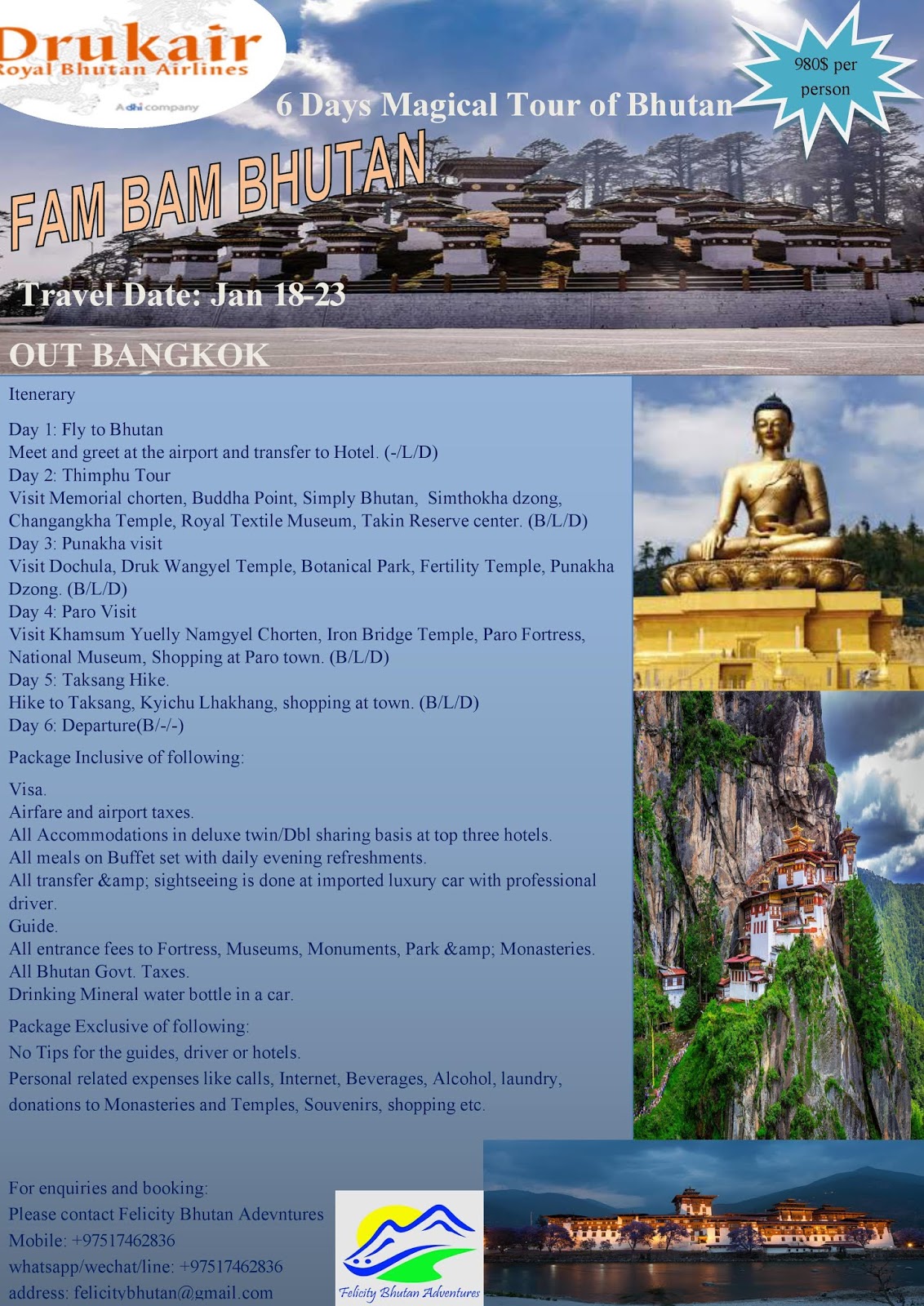
6 days magical tour of Bhutan

6 Days Magical Tour of Bhutan Travel 
Date: Jan 18-23 (More date please contact us) OUT BANGKOK Itenerary:
Day 1: Fly to Bhutan Meet and greet at the airport and transfer to Hotel. (-/L/D) ;
Day 2: Thimphu Tour Visit Memorial chorten, Buddha Point, Simply Bhutan, Simthokha dzong, Changangkha Temple, Royal Textile Museum, Takin Reserve center. (B/L/D);
 Day 3: Punakha visit Visit Dochula, Druk Wangyel Temple, Botanical Park, Fertility Temple, Punakha Dzong. (B/L/D) ;
Day 4: Paro Visit Visit Khamsum Yuelly Namgyel Chorten, Iron Bridge Temple, Paro Fortress, National Museum, Shopping at Paro town. (B/L/D) ;
Day 5: Taksang Hike. Hike to Taksang, Kyichu Lhakhang, shopping at town. (B/L/D);
Day 6: Departure(B/-/-) ;
Package Inclusive of following: 
Visa. Airfare and airport taxes. 
All Accommodations in deluxe twin/Dbl sharing basis at top three hotels. All meals on Buffet set with daily evening refreshments. 
All transfer & sightseeing is done at imported luxury car with professional driver. Guide. 
All entrance fees to Fortress, Museums, Monuments, Park & Monasteries. All Bhutan Govt. Taxes. Drinking Mineral water bottle in a car. 
Package Exclusive of following: 
No Tips for the guides, driver or hotels. Personal related expenses like calls, Internet, Beverages, Alcohol, laundry, donations to Monasteries and Temples, Souvenirs, shopping etc. 
For inquirie and booking: Please contact Felicity Bhutan Adevntures 
Mobile: +97517462836  whatsapp/wechat/line: +97517462836 
email address: felicitybhutan@gmail.com 
980$ per person


Thursday, 26 September 2019

THE WORLD HAS FEW SECRETS LEFT BUT BHUTAN IS ONE OF THEM

"THE WORLD HAS FEW SECRETS LEFT, BUT BHUTAN IS ONE OF THEM"(Kartie Hickman, Author)

The Kingdom of Bhutan is known to avid trekkers around the world as one of the last great frontiers for hiking and exploration. Nestled in the Himalayas South of Tibet and North of India, Bhutan is a predominantly Buddhist nation with deeply held customs and beliefs. With a population of just under 750,000, Bhutan prides itself as being a nation that has limited outside influences in favor of protecting the unique culture that it has known and developed for centuries. This tight regulation on outside influence has made Bhutan one of the most secluded nations in the world. For example, the television wasn't introduced into Bhutan until 1999 and the cellular phone did not arrive until 2008. Both of these technologies, as well as dozens of others, are very uncommon even today which makes traveling to Bhutan almost like taking a step back in time.


ABOUT BHUTAN
Bhutan, in its entirety, only encompasses about 47,000 sq km; about the same amount of land as Switzerland. The Southern half of the country generally remains below 3,000 meters in altitude and has a number of valleys that serve as home to a majority of the country's population. The vast majority of the country (72%) is covered in pine forests and it has been decreed by the government that at no point in the future is the country to harvest lumber below the point of 60% coverage. The Northern half of Bhutan sees a dramatic increase in altitude as some of the highest peaks in the world are found in the Bhutanese Himalayas. Containing thousands of lakes, hundreds of glaciers, and endless trekking paths, Northern Bhutan is one of the most amazing trekking destinations left in the world.


Geography
Being a predominantly agriculture-based economy with plenty of cultivatable lands; Bhutan is an exporter of many crops to India and China. The key exports are potatoes, apples, oranges, and chilies. With a small population relative to the land they have for farming, Bhutan has completely avoided using any hormones or pesticides on their crops thus making them the only fully organic country in the world. However, as is the case with most agriculture-based economies, the average income in Bhutan is quite low. But, despite the poverty, there is no noticeable homelessness as it is core to the Bhutan culture to care of one's fellow citizens in their time of need.
Bhutan made headlines in the early 2000s when it declared the primary measure of its society’s prosperity was 'Gross National Happiness'. After spending a few minutes in Bhutan you are likely to agree that people are genuinely happy and content. While the phrase may be a little humorous, it may be the best description of what makes Bhutan so amazingly different than the rest of the world in this day and age.
  

Overview of Bhutan:
The Bhutan constitution guarantees freedom of religion as long as the practice of said religion does not impose on the will of others. Therefore Christianity, Hinduism, and Islam are all found within Bhutan. However, the vast majority of the country is Buddhist and has been since the 8th century when the religion was introduced to the country. Today the Buddhist influence on Bhutanese life is unmistakable as each city is peppered with practicing Monks, the national architecture draws heavily on Buddhist lore, and many of the countries laws are written around Buddhist principles (such as it is illegal to kill any living creature).
For a relatively small country, Bhutan has a very diverse climate. In the South, the climate is generally hot and stable year-round. Temperatures generally stay between 15-30C and the humidity is sub-tropical. In Central Bhutan, there is some variety with warm wet summers and cool dry winters. In the Northernmost parts of Bhutan, one will find year-round snow on the peaks of mountains and cool weather at the base of the mountains due to the increased altitude of the region.

As the case with most countries in Southern Asia, rice forms the main portion of the Bhutanese diet. Generally speaking, two side dishes are served with rice at meals. These dishes can be either vegetable-based or meat-based. (Note: As the killing of animals is forbidden in Bhutan, all meat is imported from India) The most common vegetables eaten include pumpkin, spinach, onions, green beans. And, no dish in Bhutan would be complete without some helping of chilies. A few of the most popular dishes in Bhutan are:
1) Ema Datshi: Known to foreigners as Chilies and Cheese, Ema Datshi, the National Dish of Bhutan is a simple blend of local cheese with locally grown chilies for a spicy and creamy treat
2) Jasha Maru: Spicy minced chicken served over rice
3) Momos: Tibetan style pork, beef, or cabbage dumplings with cheese
Passed down through the generations, Bhutanese people are skilled craftsmen and craftswomen. With a focus on religious context, the Bhutanese can choose to go to school and train to become master weavers, woodcarvers, sculptors, metal workers, bridge builders, carpenters, jewelry makers, and more. School for these trades is provided to the population for free as part of a cultural preservation effort.
Facts Of Bhutan
Name of the Country: Kingdom of Bhutan
· Land of the Thunder Dragon
· Land of happiness
King: The 5th King His Majesty Jigme Gesar Namgyel Wangchuck
Queen: Her Majesty Ashi Jetsun Pema
Population: 738,267- 2011 World Bank Report
Area: 38,398 sq.km. (source – 2005 census)
Location: 88 deg 45’ East to 92 deg 10’ East in Longitude and 26 deg 40’ North to 28’ deg 15 North in Latitude
Elevation Range: 300 m (985 ft) to 7000 m (23,000 ft)
Time zone: 6 hours ahead of GMT
Capital city: Thimphu
Districts (Dzongkhags): 20 Dzongkhags
Language: Dzongkha
Religion: Mahayana Buddhism
Currency: Ngultrum (Nu)
Government: Democratic Constitutional Monarchy
Prime Minister: Dr. Lotay Tshering
Opposition Leader: Dr. Pema Gyamtsho


National Game of Bhutan
Archery is the national sports of the Kingdom. Archery was declared the national sport in 1971 when Bhutan became a member of the United Nations. Since then, the popularity of Bhutanese archery has increased and popularly played during local festivals, between public ministries and departments, and between the dzongkhags and the regional teams.
Archery in Bhutan is culturally distinctive and is a way of socialization, communication, and development of relations between people


The National Emblem of Bhutan
The National Emblem, contained in a circle is composed of a double diamond thunderbolt placed above a lotus, surmounted by a jewel and framed by two dragons. The double diamond thunderbolt represents the harmony between secular and religious power. The lotus symbolizes purity and the jewel represents sovereign power. The two dragons - male and female stand for the name of the country - the Land of Thunder Dragon (Druk Yul) which they proclaim with their thunder in unison.

The National Flag of Bhutan
The national flag of Bhutan is based upon the tradition of the Thunder Dragon of Bhutanese mythology. The Dragon is closely associated with Bhutan. The basic design of the flag by Queen Mother ChoyingWangmoDorji dates back to 1947. The National flag is a rectangle in shape that is divided into two parts diagonally. The upper yellow half signifies the secular power and authority of the king while the lower saffron-orange symbolizes the practice of religion and power of Buddhism. The dragon signifies the name and the purity of the country while the jewels in its claws stand for the wealth and perfection of the country

The National Flower of Bhutan
The national flower of Bhutan is the Himalayan Blue Poppy (Meconopsishorridula). In Bhutan, the Blue Poppy grows to a height of 1 meter on the rocky mountain terrain, above the tree line at altitudes of 3500m to 4500m. It is a delicate blue or purple tinged blossom with a white filament. The flower was discovered in 1933 by British botanist George Sherriff in a remote part of Sakteng in eastern Bhutan during an expedition in the Himalayas. Interestingly Frank Ludlow of the same expedition discovered a rare butterfly called the Ludlow's Swallowtail, another icon found exclusively in Bhutan

The National Tree of Bhutan
The Himalayan Cypress (Cupressustorolusa) is the national tree of Bhutan. This tree is associated with religion and usually found near-religious structures like Dzongs and Temples in the temperate zone between altitudes of 1800m and 3500m. To the Bhutanese, its ability to survive on rugged terrain represents bravery and simplicity.

The National Bird of Bhutan
The national bird is the Raven. The symbol of the Raven head is the most prominent component of the royal crown. In Bhutan, the raven represents the deity GonpoJarodongchen, the Raven-headed Mahakala, one of the country's chief guardian deities. The Bhutanese credit the Raven with having guided the founder of BhutanZhabdrungNgawangNamgyelto victory during the invasion from U-Tsang(Tibet) in the seventeenth century.

The National Animal of Bhutan
The national animal is the Takin (Burdorcastaxicolor). This bovid is also associated with religious history and mythology. Today it is a rare animal, and its conservation status is "vulnerable." This unique animal has the head of a sheep and body of a cow! Legend has it that this animal was conjured up by Lam Drukpa Kuenley, a Buddhist Saint notoriously famous for his crude and un-conservative ways of preaching Buddhism. There is a Takin Reserve in Thimphu for those wishing to see this strange and beautiful animal.